
'India's sizeable forex reserves should help stem a possible fall in our currency.'
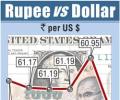
The rupee had gained 24 paise to close at nearly one-week high of 60.95 against the dollar yesterday following selling of the US currency by exporters and some banks, amid sustained heavy capital inflows.

Put plans on hold after HK caps expansion, Singapore orders stricter asset norms.

From March 3, investors in India will be able to trade in select US stocks through the NSE International Exchange (NSE IFSC), a wholly owned subsidiary of the National Stock Exchange (NSE). Investors can invest in NSE IFSC receipts on US stocks, which will be in the form of unsponsored depository receipts (DRs). For a start, this will include DRs of 50 US stocks such as Apple, Alphabet, Amazon, Tesla, Microsoft, Morgan Stanley, Nike, P&G, Coca-Cola, and Exxon Mobil. Indian retail investors will be able to transact on the NSE IFSC platform under the Liberalised Remittance Scheme (LRS) limits prescribed by the Reserve Bank of India (RBI), which currently stand at $250,000 per year.

On Friday, the rupee had gained 9 paise to close at a fresh one-week high of 67.08.
A global association for regulated funds that is leading efforts to shorten the settlement cycle for US equities has reached out to the Securities and Exchange Board of India (Sebi) with a plea to extend the T+1 implementation timeline by 18 months. The short transition period of four months does not provide foreign portfolio investors (FPIs), their services providers, and broker dealers sufficient time to make the necessary operational and compliance changes to accommodate a shorter settlement cycle, ICI Global said in its letter addressed to Sebi chairman Ajay Tyagi written a few days back. ICI Global carries out the international work of the Investment Company Institute (ICI), a global association for regulated funds, whose members manage assets of more than $42 trillion.

The Indian government and RBI must keep foreign equity investors happy and avoid crushing growth expectations, notes Akash Prakash.

If there were an Olympics for bank frauds in India, Rishi Agarwal, founder and former chairman of ABG Shipyard Ltd, a nephew of the Ruia brothers of the Essar group, would bag the gold, pushing Nirav Modi to his right, says Tamal Bandyopadhyay.

The nearly one trillion dollar EU-IMF package to bail-out Greece from its sovereign debt crisis may impact China, as it would limit options for Beijing to diversify its overseas financial portfolio and may even affect its exports.
.jpg)
The rupee slumped to a record low of 65.56 on Thursday and is headed for a sixth straight session of decline.

Finance Minister Arun Jaitley said Sebi would develop new products in the commodity derivatives space apart from taking steps to deepen the corporate bond market.
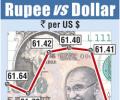
Month-end dollar demand affected the rupee

In dollar terms, the Indian markets managed to climb back to 2008 levels only in January this year. The subsequent fall in the rupee because of emerging market woes has once again pushed the markets below their 2008 level in dollar terms.

The rupee had gained by 50 paise or 0.75 per cent in two weeks.

After witnessing a decline in the past two weeks, India's foreign exchange reserves rose by $587 million to reach $1,19,932 million mark, for the week ended 18.
Huge gold imports have put pressure on the country's CAD, which in turn is affecting the value of rupee.

Sensex witnessed the biggest single day gain since May 2009 in absolute terms.
